

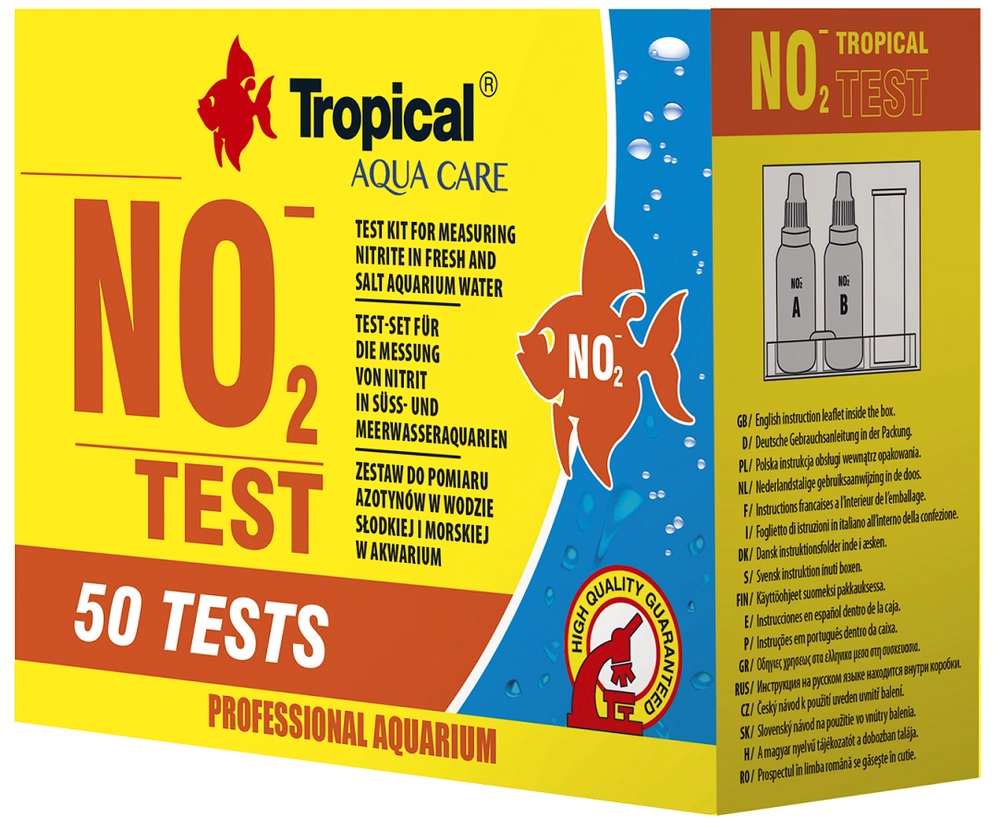
Tropical Test NO2 50 Tests

- The NO2 test is used to determine the concentration of nitrites (NO2-) in fresh and sea water, in the range of 0.0 to 3.3 mg/l. Package of 50 tests.
Tropical Test NO2 50 Tests - Product Description
What is the source of nitrites (NO2-) in an aquarium?
Fish waste, uneaten food, and other organic debris that accumulates in the aquarium are broken down by bacteria, and one of the products of this process is dangerous ammonium ions (NH4+), which in alkaline water (pH>7) partially convert into ammonia (NH3), which is very toxic to fish. In a mature and well-functioning aquarium, ammonium ions are oxidized by nitrifying bacteria during the nitrification process into less toxic nitrites (NO2-) and then into nitrates (NO3-), which are relatively safe for fish. In such aquariums, the concentration of nitrites (NO2-) is close to zero.
Why should nitrite concentration in an aquarium be monitored?
Fish are sensitive even to small concentrations of nitrites (NO2-) in the water. Values below 0.3 mg NO2-/l are considered safe. New aquariums, in which a sufficiently large population of nitrifying bacteria has not yet developed, should be monitored using the TROPICAL NO2- TEST. In addition, mature tanks in which medicinal bactericides have been used, overstocked aquariums, or those in which fish are overfed should also be monitored.
Tropical Test NO2 50 Tests - Technical Data
- Quantity: 50 tests
Additional Information
In a properly functioning aquarium, the concentration of nitrites is close to zero. However, there are situations when the concentration of nitrites increases rapidly, which may be caused by:
Insufficient population of nitrifying bacteria in a new aquarium.
Overstocked aquarium.
Overfeeding of fish.
Dead fish that has not been removed.
Use of medications that are lethal to nitrifying bacteria.
Insufficient oxygen for nitrifying bacteria due to improper aeration, prolonged power outages, filter shutdowns, or filter failure.
Cleaning or replacing all filter cartridges at the same time.
Directions for use:
1. Rinse the vial 3 times with aquarium water.
2. Fill the vial with 5 ml of the test water.
3. Add 7 drops of reagent A and mix.
4. After 15 seconds, add 7 drops of reagent B and mix.
5. After 10 minutes, compare the color of the test water with the color scale provided. Read the result by looking at it from above in daylight.
6. After completing the analysis, rinse the vial thoroughly under running water.