

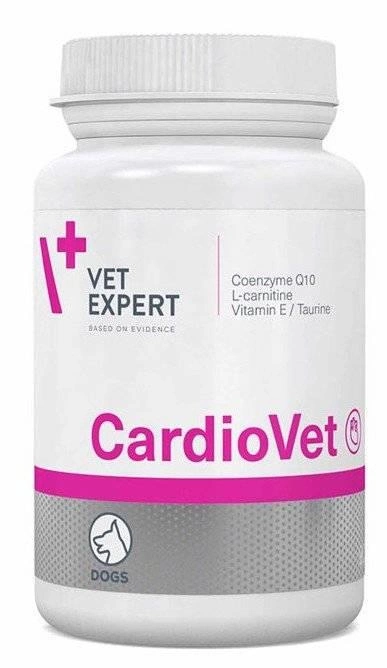
VETEXPERT CardioVet 90 Tablets

- Tablets for dogs with heart failure. The package contains 90 tablets.
Save by buying more

VETEXPERT CardioVet 90 Tablets - Product Description
The product is intended for dogs with heart failure caused by both dilated cardiomyopathy and mitral valve regurgitation.
Composition
- L-carnitine
- Taurine
- Coenzyme Q10
- Vitamin E
Composition analysis
- Protein 39.71%
- Ash 1.2%
- Fat 2.2%
- Fiber 15.78%
- Moisture 1.29%
Additives
- L-carnitine tartrate 428.6 g
- Taurine 158.7 g
- Vitamin E 95.2 g
Dosage
Dogs up to 15 kg b.w. – one tablet twice a day
Dogs over 15 kg b.w. - two tablets twice a day
The manufacturer has not limited the age and size of the animal.
Additional information
L-carnitine: is a quaternary amine formed from lysine and methionine. Its main function is the metabolism of long-chain fatty acids and energy production. The heart muscle contains as much as 95% of the total carnitine pool in the body, which clearly demonstrates its role in producing the energy necessary for the continuous work of the contracting heart muscle. L-carnitine deficiency in dogs is correlated with the occurrence of dilated cardiomyopathy, while its supplementation can protect heart muscle cells from abnormal accumulation of fatty acids inside heart muscle cells.
Taurine is one of the most important substances for proper heart metabolism. It plays a key role in myocardial metabolism by regulating calcium ion levels and osmotic potential, neutralizing free radicals, and constituting as much as 40% of the free amino acid pool in the heart. In addition, taurine has an antiarrhythmic effect, regulates the strength of heartbeats depending on the level of available calcium ions, and ensures the integrity of heart muscle cells. Taurine deficiency may be one of the direct causes of dilated cardiomyopathy in dogs.
Coenzyme Q10 (ubiquinone) is essential for energy production in the body and acts as a natural antioxidant in the mitochondria, where significant amounts of free radicals are produced as a result of the intense energy production required for the contracting heart muscle. Selenium is an integral part of the enzyme glutathione peroxidase, which acts as an antioxidant. Its action is closely dependent on vitamin E. Its main function is to counteract the effects of oxidative stress, which is one of the elements of the pathogenesis of dilated cardiomyopathy.
Vitamin E acts as an antioxidant (in combination with selenium) and also protects against excessive contraction of the endothelial cells of the heart's blood vessels and reduces platelet adhesion and aggregation in the coronary vessels, ensuring a constant flow of blood through the vessels supplying the heart.